

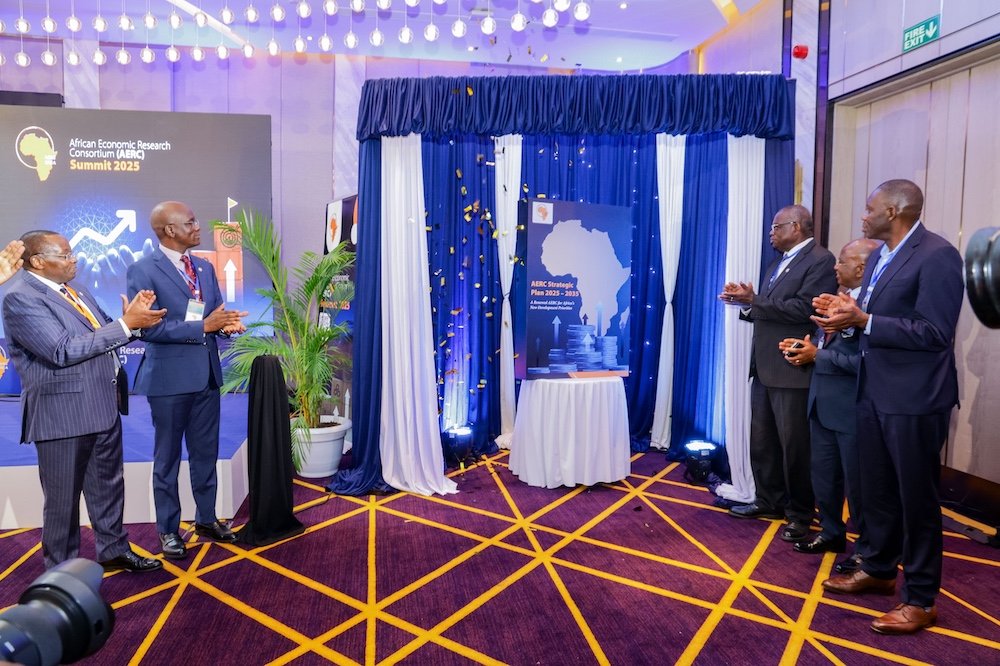
On November 30th 2025, the African Economic Research Consortium (AERC) launched its first annual high-level Research and Policy Summit in Nairobi, setting the stage for a profound shift in how the continent approaches its own development.
Under the resonant theme, “A Renewed AERC for Africa’s New Development Priorities,” the summit has brought together a formidable assembly of economists, policymakers, central bank governors, scholars, and private sector leaders, all united by a single, urgent mission: to reclaim Africa’s economic narrative.
For decades Africa’s development has been at the mercy of external prescriptions and reactive policies. Thus, the call for this reclamation came forcefully from John Mbadi, National Treasury Cabinet Secretary, who framed the summit’s ambitious spirit. He challenged the delegates to move beyond decades of externally shaped discourse and reactive policies.

“Today, we must reclaim our narrative. We must define development not merely as GDP growth, but as inclusive prosperity, resilient systems, and dignified livelihoods. Africa’s Moment is Now: Let us not be defined by our challenges, but by our courage. Let us not inherit development models—we must invent them to deliver Africa’s economic prosperity,” CS Mbadi said.
Africa must look to self-reliance and move away from foreign aid to have a future powered by Africa’s own ingenuity and abundant resources.
“For decades, foreign aid has been a lifeline, but it has also been a leash—tying our progress to external goodwill rather than our own ingenuity. That era must now start giving way to a new chapter of self-reliance, innovation, and sustainable growth. Kenya, like other African countries, is not poor in resources. We are, for instance, rich in human talent, in fertile land, in digital creativity, and in entrepreneurial spirit. What we need is not more aid, but more courage to harness what we already have,” he added.
Economic experts at the summit highlighted a pressing fiscal squeeze across Africa, driven by mounting debt repayments, unpredictable income from commodity exports, and stricter global lending conditions. This has created an urgent need to find new sources of funding.
In parallel, central bank governors including those from Uganda, South Africa, Zambia, and Central African States stressed the importance of advancing regional financial integration. They argued that deepening these connections is crucial to unlock greater access to private capital and to boost investment flows within the continent itself.
According to Professor Victor Murinde, AERC’s Executive Director, the summit provides a platform to forge a new path and launch a strategy that will take Africa to the next stage in dealing with its growing challenges. Also, with the summit aligned with the new AERC 10-year Strategic Plan (2025-2035), the plan is to nurture a new generation of African economists equipped with the right skills.
“Through the integration of research excellence, mentorship, and capacity building, the AERC aims to nurture a new generation of African economists ready to conduct frontier research, lead economic policy engagement and drive sustainable development efforts across Africa,” said Prof. Murinde.
