

African media experts have issued a strong call for transparency, accountability and ownership in the age of artificial intelligence (AI), even as much younger and digitally native audiences continue to consume news differently across the continent.
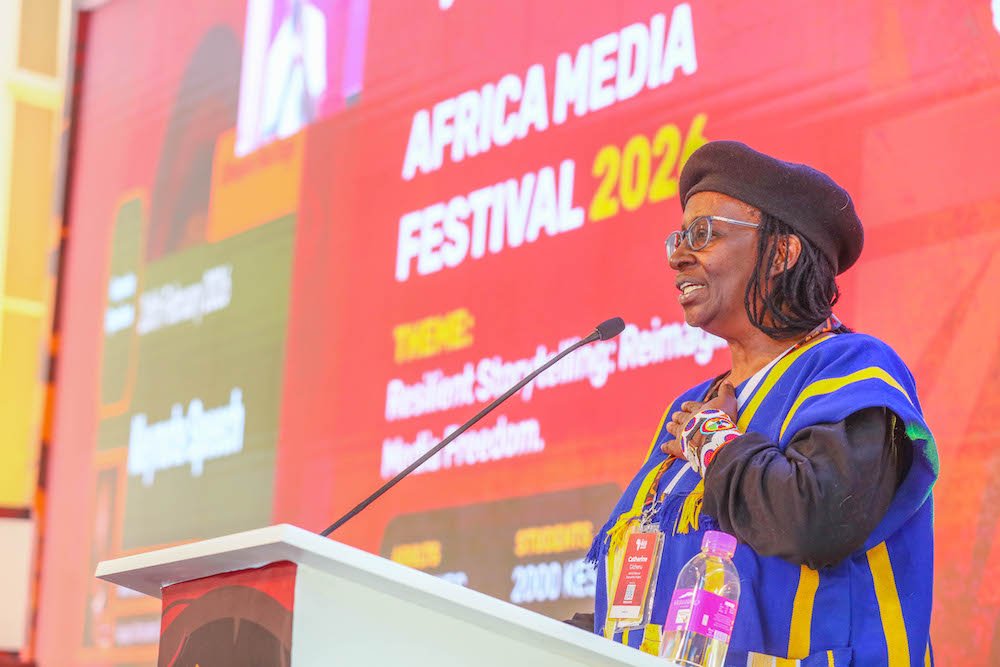
Speaking in Nairobi on Thursday, February 27, at the fourth edition of the Africa Media Festival (AMF 2026) themed “Resilient Storytelling: Reimagining Media Freedom,” Ugandan journalist and Baraza Media Lab board chair Daniel Kalinaki, said challenges affecting journalism today range from shrinking newsroom revenues and regulatory constraints, to the growing influence of digital platforms, AI, as well as a new generation of content creators.
He also called for African journalists and creators to rethink ownership by moving beyond content production to controlling platforms, intellectual property and distribution channels.
“With AI increasingly shaping the nature of how we consume information, we are seeing the emergence of fast-growing digital outlets that we perceive to be local but which in reality are foreign-owned and AI-driven, thus blurring lines between authentic journalism and externally influenced narratives,” said.
Raising urgent questions about bias, credibility and the integrity of news ecosystems, Kalinaki warned on the increasing risk of AI-generated summaries, automated content and opaque algorithms that are rapidly redefining how information is produced, distributed and consumed.
This comes against the backdrop of a generational transformation driving both media and political change across the continent.
According to martie Mtange, the curator of AMF traditional media models face significant decline or transformation, with power steadily shifting toward independent creators, smaller agile platforms and decentralised media networks.
“What lies ahead is not simply the decline of legacy institutions, but the emergence of a more decentralised, creator-driven and technologically mediated ecosystem. One that will require new models of ownership, stronger collaboration and a renewed commitment to transparency,” Mtange said.
Despite these structural challenges facing the industry, AMF 2026 closed on a celebratory note with the Africa Media Awards (AMA), recognising outstanding journalists, creators and innovators redefining storytelling across the continent. The festival also spotlighted a growing trend of political leaders opting for direct engagement through digital platforms and highly curated audiences leading to concerns about declining accountability and the manipulation of public discourse in critical socio-political and economic conversations.
A standout moment was the introduction of the ‘Creator for Good Award,’ signalling a deliberate shift toward recognising impact-driven digital storytelling and civic engagement. The inaugural award was presented to Kenyan content creator Mike Muchiri, now known as Ziya, whose work reflects a growing movement of creators using digital platforms to drive social awareness and youth engagement.
Ziya is the founder of Civic Rights Africa, a youth advocacy and policy education platform that seeks to awaken the civil rights movement among youth in the continent.
“I am deeply honoured to be the recipient of the inaugural ‘Creator for Good’ Award. Baraza Media Lab has greatly supported creators like myself who are in the civic space, who are using their platform for good. This award is therefore not just for me, it is shared with every single creator who chooses to not be silent in the face of extreme corruption, blatant disregard of our constitution, as well as for human dignity and for human life,” said Ziya.
Baraza Media Lab’s Ziya’s evolution from a comedic digital entertainer to a purpose-driven creator underscores broader shifts within Africa’s media ecosystem, where influence is increasingly tied to authenticity, identity and civic impact.
Other winners for the night included Robert Amalemba (Kenya), Umar Farouk (Nigeria), and Tracy Bonareri (Kenya) who emerged the winners, first Runners Up and second runners up in the Human Rights Journalism Award category.
Professor Kwame Karikari, who had received The Africa Editors Forum Lifetime Service to Journalism Award at the Africa Editor’s congress earlier in the week was also acknowledged for his tireless advocacy work for press freedom in the African continent.
