

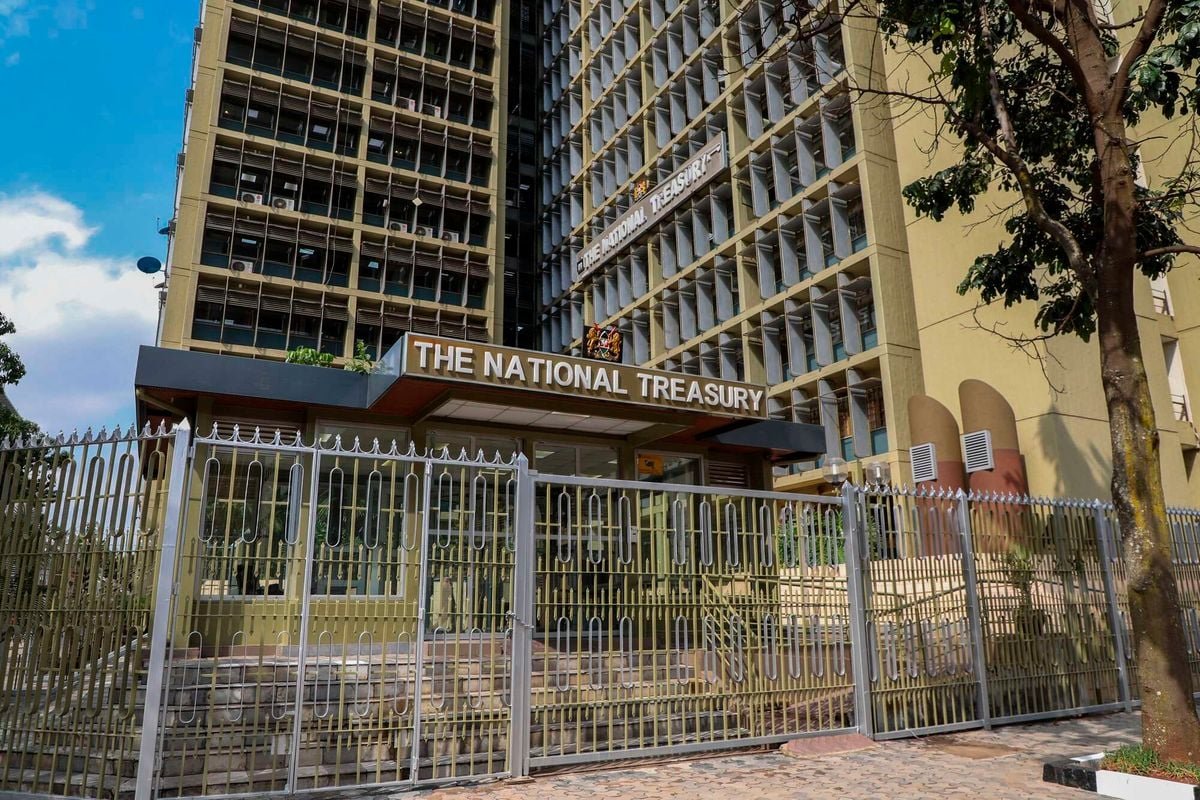
Kenya has sharply increased its domestic borrowing target for the current financial year ending June 30, raising concerns about tighter access to credit for households and businesses. New data from the National Treasury shows the target has risen by 52.29 per cent, from Sh1.09 trillion to Sh1.66 trillion, with Sh965.87 billion already secured by the end of March 2026.
The move highlights growing pressure on the local credit market, as the government turns to domestic sources such as Treasury bonds and bills largely financed by commercial banks, pension funds and insurance firms.
According to Treasury figures, the revised borrowing plan includes Sh1.12 trillion in net domestic borrowing and Sh544.25 billion for refinancing maturing debt. This marks a significant shift from earlier projections by Treasury Cabinet Secretary John Mbadi, who had initially estimated net domestic borrowing at Sh635.5 billion to support a Sh4.29 trillion budget for the 2025/2026 fiscal year.
At the same time, revenue expectations have been adjusted upwards from Sh4.43 trillion to Sh5.15 trillion. However, only Sh3.36 trillion had been collected by March, leaving a funding gap of Sh1.79 trillion to be addressed before the financial year closes.
To bridge this deficit, the Treasury aims to raise about Sh904 billion locally, while the Kenya Revenue Authority is expected to collect an additional Sh883 billion.
“The expectation is that they (KRA) might narrow that gap. It (the deficit) might seem large, but we are pushing to minimise it. The expectation is that they (KRA) might narrow the gap, but domestic borrowing is where we have a challenge,” said Albert Mwenda, the director-general of budget, fiscal and economic affairs at the Treasury. Officials say the government is also exploring external financing options to ease reliance on domestic borrowing. These include tapping into remaining proceeds from a Eurobond, estimated at Sh150.76 billion, and engaging development partners.
“But there are also other avenues to borrow externally which are being considered; it doesn’t mean that the entire Sh900 billion will be raised from the domestic market. It is only that you cannot plan or indicate that external alternative borrowing until it is confirmed, but I can say Treasury is also working on other avenues to minimise domestic borrowing,” he said.
“We still have money that we have the flexibility to use to fund the budget. Even if we used part of the proceeds of the Eurobond to pay the debt early, there is still a balance that is accessible. Even if we didn’t receive any other money, it is positive that the government has additional resources, so we are not exposed,” Mr Mwenda said.
Further discussions are ongoing with the World Bank over the potential release of $750 million (Sh97.5 billion) under Development Policy Operation 7 (DPO 7), which had previously been delayed due to unmet governance requirements.
“We have not factored IMF funding into the current fiscal plan for the current fiscal year. We don’t have any funding from the IMF because negotiations are still going on. For the World Bank, there is still engagement with the Treasury on DPO 7. You know there is funding that the World Bank was to provide, and there are engagements with a view to having them release those funds to us,” he said.
“There is, I think, one area that they are still engaging the government on. Most of the others, like the regulations that were to be done, have all been done. It is just one area that we are engaging with the World Bank on. It is just the issue of macro adequacy. They have to do their own assessment of macro adequacy. They are in the process of doing that, and there are consultations on that going on. It just means looking at our fiscal plan, if the revenues do make sense, the capacity of the country to raise revenue and things like that,” said Mr Mwenda.
“There is a chance (to release the funds this financial year) as long as there are engagements. You can only say there is a risk, but there is also a high chance that these funds will come, which is why we have not written them off.”
The current budget has also expanded to Sh4.695 trillion through the Supplementary Appropriations Act (2026), up from an initial estimate of Sh4.3 trillion, reflecting increased expenditure demands.
Originally, the fiscal deficit-estimated at Sh923.2 billion after grants was to be financed through a mix of Sh287.7 billion in external borrowing and Sh635.5 billion in domestic borrowing. However, the revised figures signal a heavier dependence on the local market, intensifying concerns over reduced credit availability for the private sector.
