

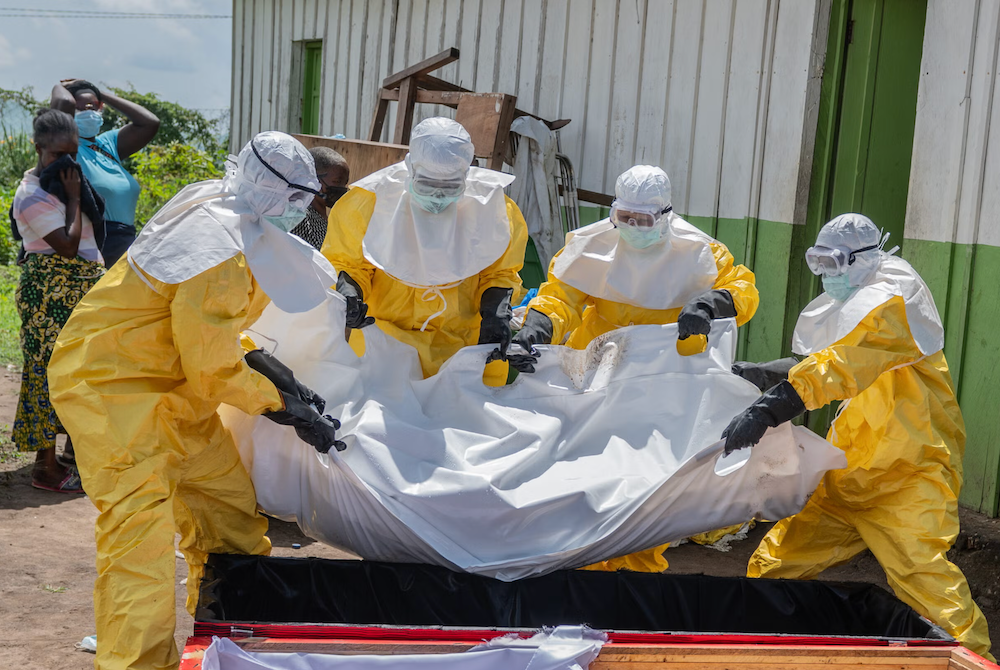
As the Democratic Republic of Congo confronts its 17th Ebola outbreak, now one of the most rapidly expanding outbreaks in the country’s history, neighboring South Sudan is racing to prevent the deadly virus from spreading across its borders, warning that armed conflict, widespread displacement and porous borders have left the country more vulnerable.
The latest projections suggest the outbreak is progressing northwards toward South Sudan after spreading across five provinces in the DRC.
The warning is also important for Kenya. Kenya’s strong ties with Uganda and South Sudan mean that any escalation of the outbreak could rapidly challenge regional disease surveillance systems and emergency response capacity.
“We don’t have any confirmed case of Ebola in South Sudan. However, the risk of its importation remains high, primarily because of cross-border movements and trade with the DRC and Uganda,” said the country’s acting WHO representative, Moses Ongom.
The caution comes as the Bundibugyo strain outbreak continues to intensify in eastern DRC.
WHO-backed surveillance data indicate the number of cases has risen to 1,947, including 704 fatalities and 336 recoveries. The DRC has reported 1,926 cases, 702 deaths and 318 recoveries, as transmission expands from the initial epicentre in Ituri Province into four other provinces.
“This epidemic is still out of control in DRC. It has not yet reached its peak, and that poses a great risk for us (South Sudan),” said Dr. Ongom.
The rate of transmission has worried health officials. The ongoing epidemic surpassed 1,000 infections within 40 days of the response being initiated, compared with roughly 235 days during the country’s significant 2018 North Kivu Ebola epidemic.
Beyond its borders with the DRC and Uganda, prolonged insecurity and the humanitarian crisis have complicated public health surveillance in South Sudan.
“We have porous borders with DRC and Uganda. We also have displacement and humanitarian movements between the countries. These pose a high risk,” Ongom said.
To enhance its readiness, South Sudan has invested in expanding diagnostic services, building the capacity of healthcare workers, improving infectious disease response mechanisms, stocking critical medical supplies and increasing risk communication efforts. Health screening at key border crossings, such as Nimule, Kaya, Olipui, River Yei and Juba International Airport, has also been reinforced to support early case detection.
“All Ebola preparedness and response mechanisms continue to be activated to strengthen our health system readiness,” said the ministry’s Undersecretary, Dr. Oromo Francis.
“So far, cumulatively, since screening started, about 390,000 travellers have been screened through the points of entry, the majority through Nimule.”
Disease surveillance teams have identified 15 high-risk counties along the borders with Uganda and the DRC, where community health workers carry out routine daily monitoring to detect suspected infections.
Taking the response closer to the source of the outbreak, Uganda has deployed healthcare teams to the DRC while establishing laboratory capacity to strengthen surveillance and enable faster diagnosis.
During the 2014 West African Ebola epidemic, Kenya prevented the virus from reaching the country by implementing intensive border surveillance, strengthening emergency preparedness and educating health professionals. It also deployed epidemiologists, laboratory technicians and crisis management teams as part of the AU-led African Support to Ebola Outbreak in West Africa programme.
– By Salome Thiani
