

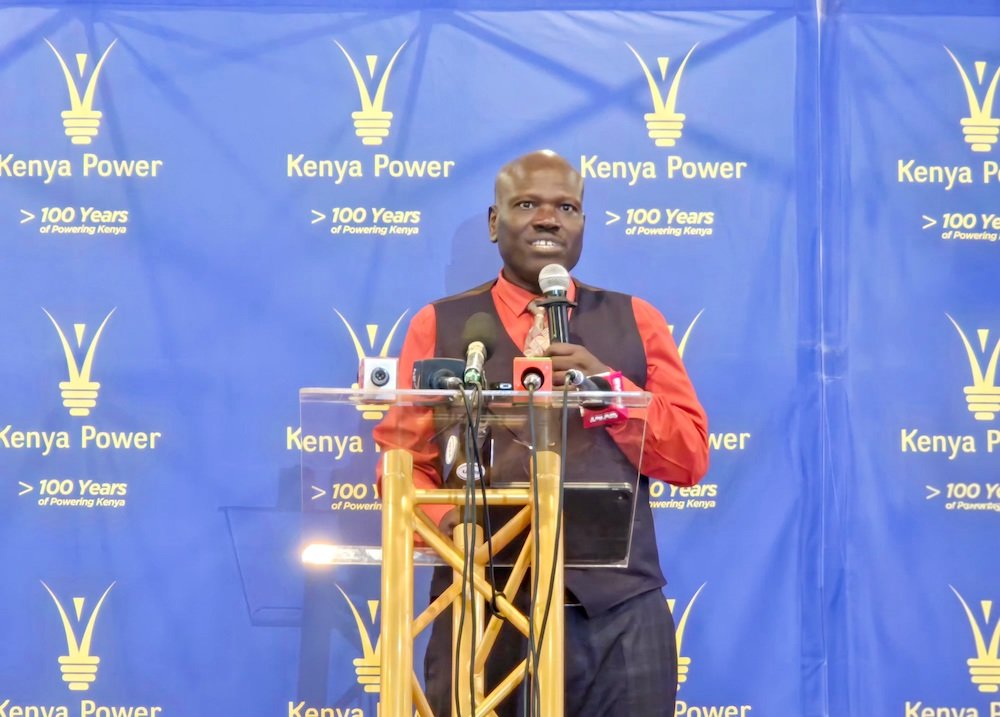
Kenya Power Managing Director and Chief Executive Officer Dr (Eng) Joseph Siror has called for increased investment in baseload generation to support the growing contribution of solar and wind power to the national grid.
Dr. Siror said Kenya must expand reliable generation capacity to manage fluctuations in electricity output from variable renewable energy (VRE) sources and maintain power quality.
Speaking during a State of the Grid briefing, Dr. Siror said changes in solar and wind generation can affect the balance between electricity supply and demand, with variations reflected in the system’s frequency and voltage.

“Grid stability is dependent on two key factors, generation and demand,” he said.
He explained that solar generation can fall sharply when clouds block sunlight, creating an immediate gap between available supply and demand that must be addressed by other generation sources.
The Kenya Power CEO said the country’s VRE penetration currently stands at about 21 per cent, with solar and wind contributing significantly to the generation mix.
He said the growing contribution of these sources should be matched with investment in dependable generation, particularly geothermal and hydroelectric power.
Kenya has an estimated 9,000 megawatts (MW) of geothermal potential, while about 1,200 MW of hydroelectric potential is under development.
Dr. Siror identified several projects that Kenya Power considers critical to strengthening the electricity system, including the 700 MW High Grand Falls hydro project, the 90 MW Karura Falls project and the 100 MW Paka Silali geothermal project.
He also cited KenGen Olkaria 7, with a planned capacity of 80 MW, and the proposed raising of the Masinga Dam level by 1.5 metres as projects that could contribute additional electricity to the grid.
The MD said the projects require sustained attention and support to accelerate their implementation, urging investors to prioritise developments that can provide firm electricity capacity.
He further called for the development of fast-ramping generation technologies capable of responding quickly when renewable output changes.
According to Dr. Siror, sudden reductions in solar or wind generation can require power stations to increase production within a short period to maintain the supply-demand balance.
Battery Energy Storage Systems can also provide support by storing electricity and releasing it when required. However, he noted that storage has limitations when renewable generation remains low for prolonged periods.
Dr. Siror said fast-ramping plants would therefore complement renewable sources by increasing or reducing their output according to changes in electricity demand and renewable generation.
He cautioned against assessing the cost of solar and wind power solely by looking at their generation tariffs, saying the overall cost should also consider the infrastructure and generation capacity required to manage their variability.
“When we look at variable energy sources, do not just look at the cost on its own. Look at the cost of it and the mechanism to support it,” he said.
Dr. Siror, however, stressed that Kenya should continue investing in renewable energy rather than slowing its development.
“We really need them to meet the shortfall,” he said, adding that the country should simultaneously fast-track baseload generation.
He said geothermal power has already demonstrated its value to Kenya’s electricity system because it provides continuous generation and can help meet demand when other sources are unavailable.
The Kenya Power chief said the country’s substantial geothermal and hydro resources present an opportunity to expand electricity supply while maintaining a stable system.
He urged investors to channel resources towards priority generation projects, saying stronger generation capacity would improve power quality, support industrial activity and provide a firm foundation for the continued integration of renewable energy into the national grid.
– By Sharon Njeru and Zipporah Odionyi, KNA
