

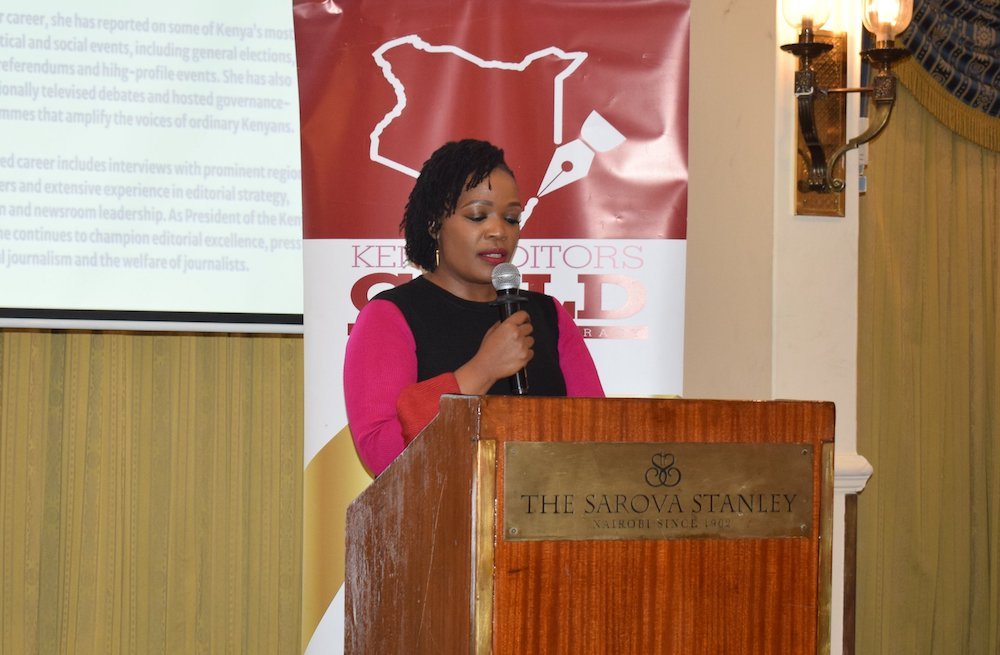
Kenya’s editors and journalists are seeking greater access to information on government borrowing and complex financing arrangements, amid concerns that weak disclosure is making it difficult to assess the risks and obligations attached to public funds.
The Kenya Editors Guild (KEG) raised the issue during a peer-to-peer engagement on complex and high-risk public financing in Nairobi on Thursday, where journalists examined gaps in reporting on public debt and government financing arrangements.
KEG president Zubeida Kananu said newsrooms needed to look beyond official accounts and examine the financial commitments created by such deals.
“Our responsibility as editors and journalists is not simply to report what institutions tell us. We have a responsibility to ask the difficult questions,” Kananu said.
The discussions highlighted limited access to credible information, the technical complexity of financing arrangements, weak disclosure of loan agreements and guarantees, and fragmented responses from public institutions.
These gaps can make it difficult for the public to establish the full cost and risk of government financing, particularly where agreements involve guarantees, repayment obligations, procurement arrangements and contingent liabilities.
Kananu said journalists should establish who bears the risks in public financing arrangements, what guarantees have been provided, how procurement was conducted and what repayment obligations ultimately fall on taxpayers.
“Yet these issues have very real consequences for citizens and for the country,” she said.
The engagement, organised by KEG in partnership with the International Republican Institute (IRI), follows a June roundtable on public debt accountability and fiscal justice.
The guild plans to consolidate the issues raised by journalists into a Media Issues Paper setting out information gaps, evidence needed and questions for public institutions.
The paper will form the basis of an institutional dialogue scheduled for September 17. Kananu said the meeting should focus on specific issues identified by journalists rather than general discussions on public finance.
“We want the media to arrive at that dialogue with clearly articulated questions, supported by evidence and grounded in the experiences of journalists working in newsrooms,” she said.
The engagement is the first of five planned by KEG and IRI to strengthen media scrutiny of complex and high-risk public financing.
For businesses and investors, closer scrutiny could improve public understanding of the financial commitments and risks embedded in government financing arrangements, particularly where information on guarantees and repayment obligations is difficult to obtain.
