

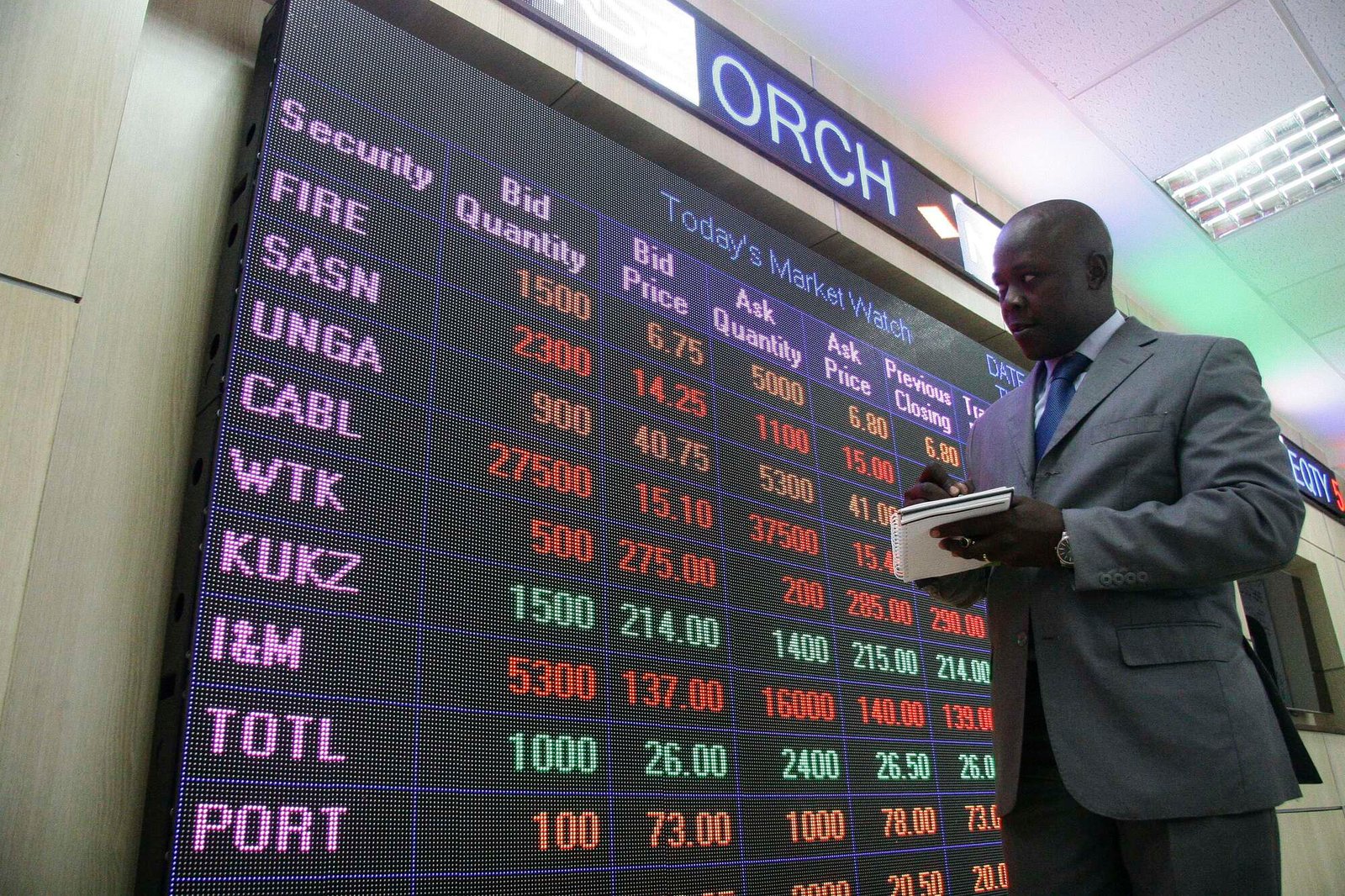
A growing number of companies listed on the Nairobi Securities Exchange (NSE) are increasing shareholder dividends even as their profits decline, as management teams come under pressure to reward investors regardless of weaker earnings.
Regulatory filings show nine listed firms either raised or held steady their dividend payouts despite falling profits, while a further nine increased payouts at a pace outstripping their actual earnings growth.
Among those raising dividends despite lower profits are Absa Bank Kenya, Standard Chartered Bank Kenya, BOC Kenya, Centum Investment Company and Kenya Power. TPS Eastern Africa, CIC Insurance Group, Kenya Re and Liberty Kenya Holdings, meanwhile, chose to hold their payouts steady even as earnings weakened.
“The general trend on the NSE over the past two years is that share prices have gone up, with investors moving away from fixed-income instruments and more into equities. There could be some pressure on management to ensure that they deliver returns commensurate with their share price,” said Erick Musau, executive director for research and sustainable finance at Standard Investment Bank.
BOC Kenya offers one of the clearest examples of the trend, lifting its interim dividend by 60 per cent to Sh4 per share even as net profit for the half year to June fell 39.8 per cent to Sh100.37 million.
Absa raised its dividend per share by 150 per cent, from Sh0.20 to Sh0.50, despite a 9.8 per cent drop in net profit to Sh10.53 billion, while StanChart increased its payout by 6.3 per cent to Sh8.50 even as earnings fell 16.8 per cent.
Absa Kenya, majority-owned by South Africa’s Absa Group, said the increase reflects confidence in its underlying capital position rather than any strain on the business. “We have done what we call stress tests on our business, and we are comfortable with our capital levels. So with that, we say we can distribute more earnings,” said Yusuf Omari, Absa Kenya’s interim CEO.
Musau noted that firms with multinational parent companies as anchor shareholders, such as StanChart, BAT Kenya and East African Breweries PLC (EABL), have a particular incentive to keep dividends high, since dividends are often the primary channel through which those parent companies extract value from their Kenyan operations.
Other firms have gone further still, increasing dividends at a rate well ahead of profit growth. TotalEnergies Marketing Kenya raised its dividend by 79.7 per cent to Sh3.45 per share after profit grew 45.6 per cent, while BAT Kenya lifted its full-year dividend by 40 per cent to Sh70 on the back of 17.1 per cent profit growth. EABL increased its payout by 59 per cent to Sh12.70 after net profit rose 49.4 per cent.
Banking sector dividends have followed a similar pattern of outpacing profit growth. NCBA raised its full-year 2025 dividend by 29.1 per cent to Sh7.10 per share, against profit growth of just 7 per cent to Sh23.4 billion, and followed up with a 50 per cent rise in its 2026 interim dividend to Sh3.75 as first-half profit grew 12.2 per cent.
KCB increased its 2025 dividend per share by 133 per cent to Sh7, partly reflecting proceeds from the sale of National Bank of Kenya, against profit growth of 11 per cent to Sh68.4 billion, while its interim dividend rose 50 per cent to Sh3 as first-half profit grew 14.2 per cent.
Not every firm facing weaker earnings chose to raise payouts; some opted simply to hold them steady. TPS Eastern Africa maintained its Sh0.35 dividend despite a 40.2 per cent fall in profit to Sh787.2 million.
CIC Insurance kept its payout at Sh0.13 even after an 82 per cent collapse in earnings to Sh513.8 million, while Kenya Re held its dividend at Sh0.15 despite an 11.6 per cent profit decline to Sh3.92 billion, and Liberty Kenya retained its Sh0.50 payout despite a 65.3 per cent drop in profit to Sh487 million.
