

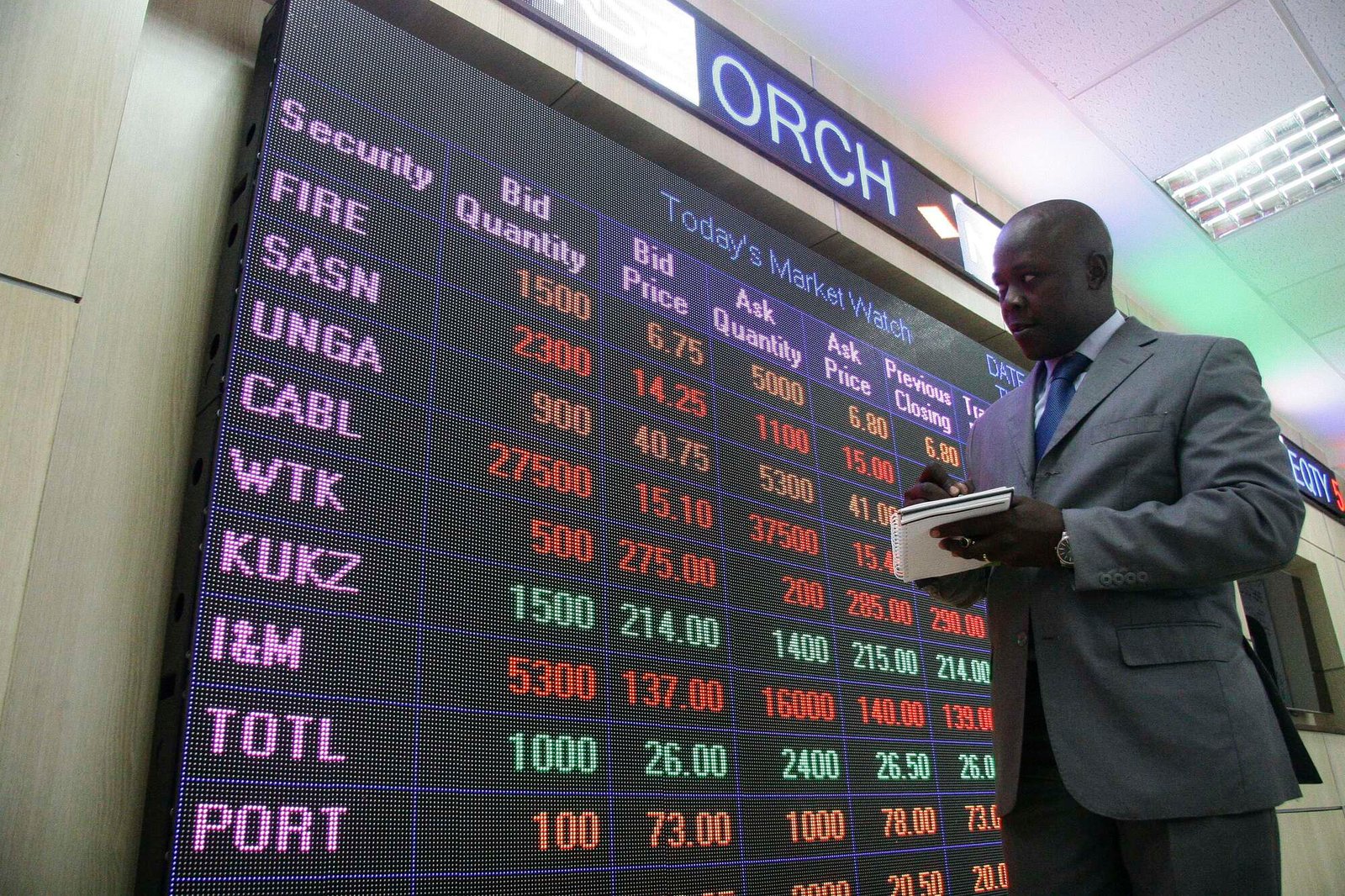
The Nairobi Securities Exchange has shed Sh158 billion in investor wealth over the past week, as investors moved to lock in profits from blue-chip stocks that had driven the market’s rally through August, compounded by rising global jitters over the Middle East conflict.
Market capitalisation, the standard measure of total investor wealth on the exchange, fell to Sh4.126 trillion at the close of trading on Tuesday, down from the all-time high of Sh4.285 trillion recorded on September 3. Four large counters, Safaricom, Equity Group, KCB Group and Co-operative Bank of Kenya, led the correction, together accounting for Sh113.6 billion of the total capital lost over the period.
The same stocks had been the primary drivers of the rally that first pushed the bourse’s market capitalisation past the Sh4 trillion mark in mid-August, with Equity, KCB and Co-operative Bank all touching all-time highs of Sh106, Sh98.55 and Sh38.55 per share, respectively, just a week before the reversal began.
The scale of the individual losses was significant. Safaricom’s share price closed at Sh36.50 on Tuesday, cutting the telco’s total valuation by Sh58 billion since September 3 to Sh1.46 trillion. Equity Group closed at Sh101.75 per share, shedding Sh16 billion in value from its all-time peak of Sh400 billion.
KCB Group’s share price stood at Sh90 at Tuesday’s close, a Sh27.4 billion drop in valuation to Sh289.2 billion, while Co-operative Bank lost Sh13.8 billion to settle at Sh212.4 billion after its share price fell to Sh36.20.
Melodie Ndanu, a research analyst at Standard Investment Bank, said the sell-off reflected investors cashing in gains built up earlier in the year rather than any fundamental weakness in the stocks themselves.
“The correction on large counters over the last few days is mainly due to investors taking profits and locking in substantial capital gains after the strong rally over the first half of the year,” she said. She added that global developments were also weighing on sentiment.
“Investors are also pricing in the potential impact of higher crude oil prices on inflation following the developments in the US-Israel-Iran tensions, and the implications of the upcoming decision by the US Federal Reserve regarding interest rates given economic conditions.”
The sell-off has coincided with escalating tensions in the Middle East stemming from the US-Israel conflict with Iran, alongside attacks by Yemeni Houthi rebels on Red Sea shipping routes that have pushed benchmark oil prices higher and stoked fears of renewed global inflationary pressure.
Those pressures were visible in bond markets too; the yield on US 10-year Treasury bonds crossed the closely watched 5 per cent threshold on Monday for the first time since 2023, as investors priced in the likelihood that the Federal Reserve will keep interest rates higher for longer in response to renewed inflation risk.
Because the US 10-year yield is widely tracked as a gauge of global inflation expectations, movements in the rate tend to ripple through investor behaviour worldwide. For equity markets specifically, higher US bond yields, particularly when paired with a strengthening dollar, typically trigger capital flight from smaller, riskier markets as investors chase safer returns elsewhere, weighing down share prices in markets favoured by foreign investors, including Kenya.
Foreign investors have been active participants in the recent pullback. They sold shares worth Sh4.55 billion in August alone, taking advantage of the blue-chip rally to secure profits, with net sales accelerating through the second half of the month as Safaricom, Equity and KCB climbed toward their multi-year and all-time highs.
That trend has continued into September, with foreign investors recording a further Sh1.6 billion in net outflows during the first two weeks of the month, even as some local investors joined in the profit-taking.
“Foreign investors may also be using the rally opportunity to exit and reallocate funds toward safer global assets as the global outlook shifts,” Ndanu said. Shares offloaded by foreign investors have largely been absorbed by local corporate investors, particularly cash-rich fund managers and pension schemes diversifying away from government bonds as interest rates on those instruments have declined.
Foreign investor activity on the NSE tends to concentrate heavily on a handful of large, liquid counters, including Safaricom, Equity, KCB, Co-operative Bank and EABL, stocks with sufficient trading volumes to support sizeable buy and sell orders with relative ease.
Much of that concentrated attention traces back to their inclusion in the Morgan Stanley Capital International (MSCI) frontier and small-cap indices, closely watched benchmarks that amplify both inflows and outflows for the stocks included in them.
As of the most recent review in May 2026, Safaricom, Equity Group, EABL, KCB Group, Co-operative Bank and Standard Chartered Bank Kenya featured on the MSCI Frontier Markets Index, while BAT Kenya, KenGen, Kenya Re, Kenya Power, DTB Group, Carbacid, Bamburi Cement, Jubilee Holdings, CIC Insurance Group, Centum Investment and HF Group featured on the MSCI Frontier Markets Small Cap Index.
In total, 17 Kenyan companies are represented across the two indices, selected based on criteria including liquidity and financial stability, a listing that gives them meaningful exposure to foreign investor interest and supports more active price discovery.
Other markets included alongside Kenya on the frontier indices include Zimbabwe, Tunisia, Morocco, Nigeria, Senegal, Mauritius and Cote d’Ivoire, while South Africa and Egypt, Africa’s largest and most liquid markets, are classified separately by MSCI as emerging markets.
