

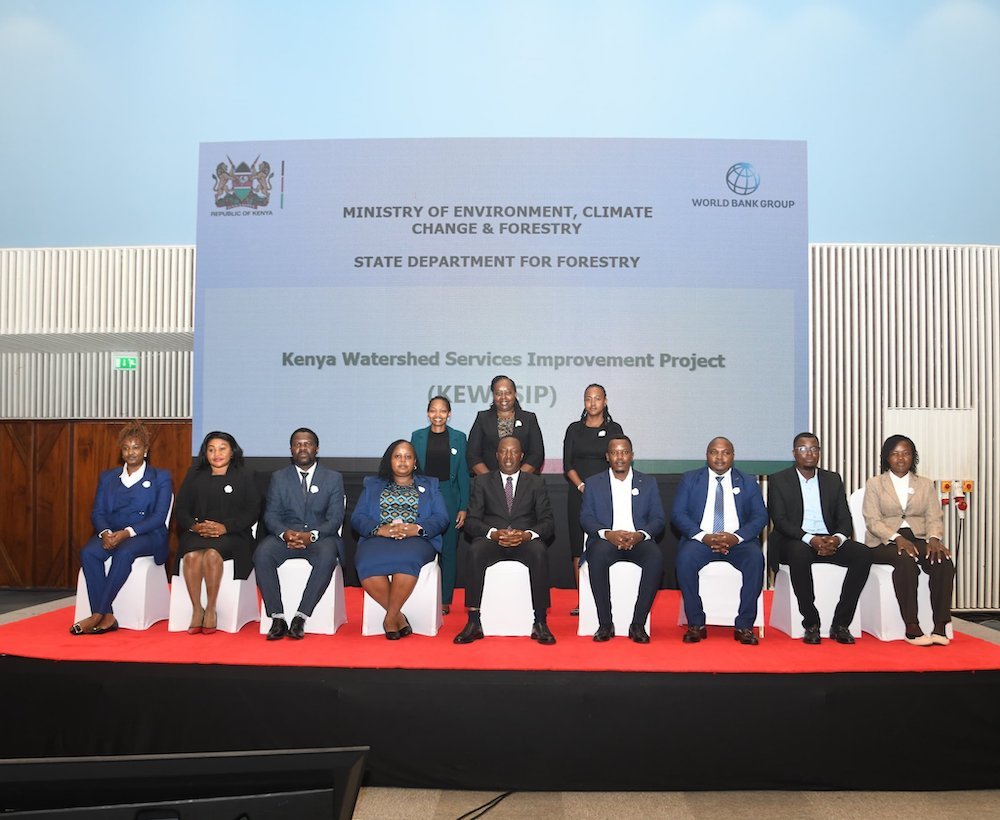
The Kenya Forest Service (KFS) has launched the Kenya Watershed Services Improvement Project (KEWASIP), a bold five-year mission funded by the World Bank, to breathe life back into degraded watersheds across twelve pilot counties.
The launch, presided over by Gitonga Mugambi, Forestry Principal Secretary, represents the largest single investment in the forestry sector since independence.
According to Alex Lemarkoko, the Chief Conservator of Forests (CCF), this is an opportunity and a responsibility that KFS does not take lightly. He framed the project as the engine that will accelerate the national goal of growing 15 billion trees and reaching 30% forest cover by 2032.

However, KEWASIP’s vision stretches beyond planting. It is woven into the National Landscape and Ecosystem Restoration Strategy, aiming to secure the very watersheds that sustain communities and economies.
In fact, KFS has already mapped 82 tree nurseries across the targeted counties, laying the groundwork to produce a staggering one billion seedlings. The project’s ambition is not confined to the tree line. In counties like Isiolo, Tana River, Garissa, and Baringo, where communities grapple with the stranglehold of invasive Prosopis, KEWASIP will seed hope of a different kind through nature-based enterprises.
These ventures are designed to turn restoration into employment, offering new livelihoods for youth and local populations while reclaiming the land. The other counties set to benefit from KEWASIP are Meru, Tharaka-Nithi, Kwale, Makueni, Laikipia, Samburu, Marsabit, and Kitui.
Principal Secretary Mugambi issued a rallying cry for collaboration, urging all implementing agencies and county governments to unite in support as well as pledging his support to the project. “We must work together to ensure KEWASIP delivers lasting benefits,” he said.
The launch event, which took place in Nairobi, brought together key architects of this green renewal, including representatives from KEFRI, NETFUND, the project coordination team, and the World Bank.
With its launch, KEWASIP stands as a beacon of hope for landscape recovery, community empowerment, and a sustainable green future.
