

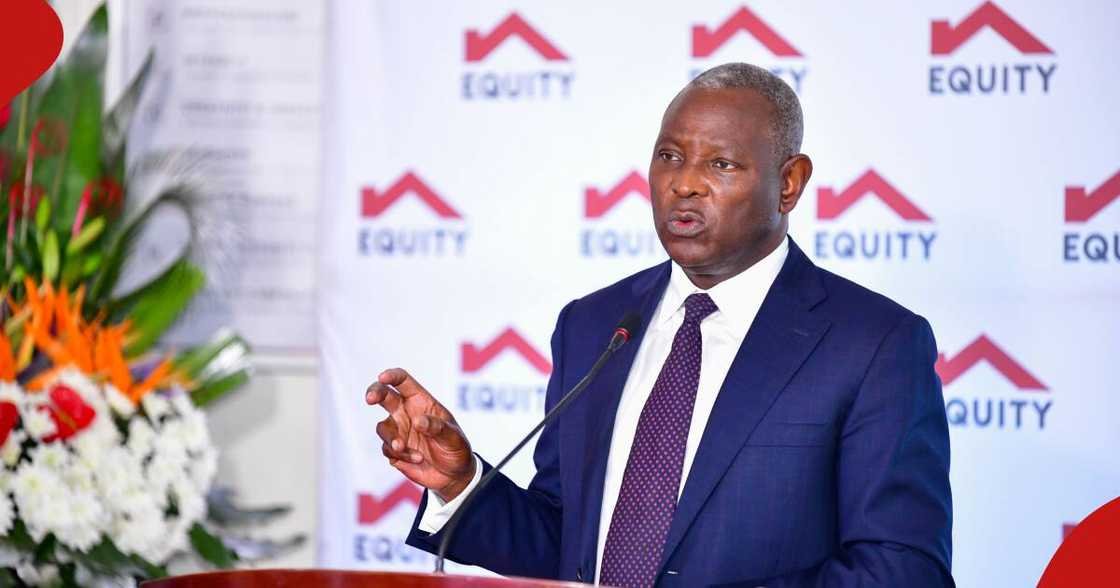
Equity Group Holdings has posted a net profit of Sh71.5 billion for the nine months to September 2026, up 32 per cent from Sh54.1 billion a year earlier, driven by strong regional operations, faster lending and higher fee income. The group released the results on Tuesday, November 17, 2026.
Total income rose 23 per cent to Sh192 billion, from Sh156.2 billion, while profit before tax climbed 37 per cent to Sh89.8 billion. Group Managing Director and Chief Executive Dr James Mwangi said the results showed that the group’s long-term strategy was paying off.
“Equity’s Q3 2026 performance reflects the successful execution of a multi-year transformation agenda that has strengthened the Group’s resilience, diversified its earnings base and enhanced operational scalability through technology,” he said.
Non-funded income, which includes fees, commissions and foreign exchange trading, rose 34 per cent to Sh84.3 billion, lifting its share of total income to 44 per cent from 40.1 per cent a year earlier. Net interest income grew 15 per cent to Sh107.7 billion, from Sh93.5 billion.
Total assets grew 18 per cent to Sh2.15 trillion, from Sh1.82 trillion, as customer deposits rose 19 per cent to Sh1.58 trillion and net loans increased 17 per cent to Sh1.01 trillion. Shareholders’ funds rose 22 per cent to Sh369.7 billion.
The cost-to-income ratio improved to 47.9 per cent from 50.6 per cent, which the group attributed to higher productivity, shared services and greater use of digital channels. The group’s return on average equity was 27.2 per cent, while its return on average assets stood at 4.6 per cent.
Asset quality also improved. The ratio of non-performing loans fell to 9.3 per cent from 12.1 per cent, while the cost of risk eased to 1.5 per cent from 1.9 per cent. Provisions covered 71 per cent of bad loans.
Mwangi said the markets where Equity operates continued to offer good growth prospects, despite global tensions and rising prices in some countries.
“Across our markets, economic growth remains supportive, with Kenya expected to grow by 4.5%-5% and our regional subsidiaries continuing to operate in some of the world’s fastest-growing economies,” he said.
Equity Bank Kenya increased its net profit by 31 per cent to Sh40.7 billion, from Sh31.1 billion. Its deposits rose 10 per cent and its loans 12 per cent, while it posted a return on equity of 35.2 per cent.
The bank remains Kenya’s biggest lender to small businesses, having issued 34 per cent of the Sh245 billion in loans extended to micro, small and medium enterprises (MSMEs) between January and June 2026.
The group’s regional subsidiaries accounted for 42 per cent of its banking profit, 50 per cent of banking revenue, 54 per cent of deposits and 55 per cent of loans. Equity BCDC in the Democratic Republic of Congo grew its profit by 34 per cent to Sh18.5 billion, while Equity Rwanda’s profit rose 10 per cent to Sh4.4 billion and Equity Tanzania’s increased 60 per cent to Sh2.4 billion.
The group’s insurance arm, Equity Insurance Group, grew its gross written premiums by 52 per cent to Sh10 billion and its profit before tax by 34 per cent to Sh1.96 billion. It has issued 23.7 million life insurance policies, 80 per cent of them through digital channels.
Equity serves more than 24 million customers on its digital platforms, with 89.5 per cent of all transactions conducted digitally. Its physical network comprises 411 branches, 883 ATMs, 95,510 agents and 1.4 million merchants.
Its healthcare arm, Equity Afya, has expanded to 159 medical centres, which have recorded more than 5.7 million patient visits.
The group also continued to invest in its staff and communities. It said 97 per cent of its employees had completed a course in generative artificial intelligence.
Through the Equity Group Foundation, its Wings to Fly and Elimu scholarship programmes have supported 60,009 students, while the foundation has trained more than one million entrepreneurs.
Looking ahead, Equity said it would continue rolling out its Africa Recovery and Resilience Plan 2030, which aims to expand the group into 15 countries and reach 100 million customers.
“As we advance our Africa Recovery and Resilience Plan (ARRP) 2030 ambitions, we continue to evolve beyond traditional banking into an integrated financial services platform that mobilises capital, connects customers to opportunities and drives inclusive economic growth across Africa,” Mwangi said.
