

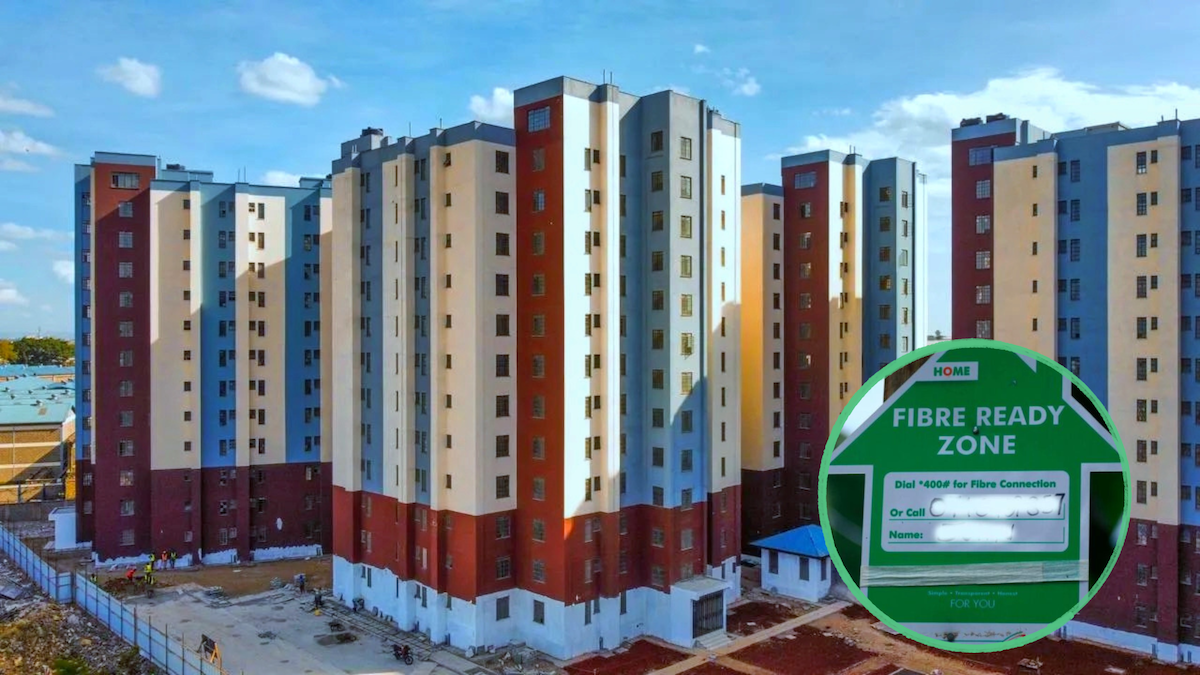
Safaricom has secured a contract to provide internet connectivity to homes built under Kenya’s Affordable Housing Programme.
Connectivity is already live at the first phase of the Mukuru Affordable Housing project in Nairobi, which was officially launched in May.
All 14,000 housing units at Mukuru will have internet pre-installed before Safaricom extends the service to other Affordable Housing Programme developments across the country.

The agreement positions Safaricom to expand its fixed broadband footprint as more affordable housing units are completed nationwide.
Vodacom Group, Safaricom’s South African parent company, first disclosed the agreement in its latest investor communications.
“In Kenya, we are extending fibre to low-cost government housing developments, ensuring that affordable housing includes digital connectivity from the outset,” Vodacom said in its latest disclosure.
The initiative broadens Safaricom’s fixed broadband business beyond conventional fibre-connected estates while supporting Vodacom’s regional broadband expansion strategy.
Vodacom said its fibre footprint would expand to about 3.6 million homes passed once its planned transaction to take a controlling stake in Safaricom is completed.
Safaricom later confirmed that the rollout will extend beyond Mukuru, with the telco planning to connect affordable housing projects across the country.
“We will roll out similar services to the other housing projects across the country under the Affordable Housing Programme,” a Safaricom spokesperson told the Business Daily.
The connectivity will be delivered through Wi-Fi Bamba, Safaricom’s tokenised fibre broadband service, which is designed to provide a lower-cost alternative to conventional home fibre.
- Safaricom expansion plans face new government approval rule
- Parliament nods to $1.91 billion Safaricom divestiture
- Safaricom revenue hits Sh388.7 billion as diversification pays off
At Sh800, the plan delivers speeds of up to 15 megabits per second (Mbps) and supports up to three connected devices simultaneously.
The package is significantly cheaper than Safaricom’s standard Home Fibre plans, which start at Sh2,999 per month for 40Mbps.
While standard fibre installations require cable splicing on site, Wi-Fi Bamba runs on a single plug-and-play connection, cutting both installation time and deployment costs.
This makes the service well suited to the Affordable Housing Programme, where rapid deployment, lower installation costs and flexible payment options are expected to be key considerations.
Safaricom has also signalled plans for tokenised Wi-Fi access with hourly, daily and weekly payment options, emulating Kenya’s pay-as-you-go mobile data model.
According to the Communications Authority of Kenya’s third-quarter 2025/26 sector report, Safaricom remained the country’s largest fixed broadband provider as of March, with 941,501 subscriptions, representing 35.5 per cent of the market share.
The affordable housing contract adds to a growing list of government-linked technology projects undertaken by Safaricom, including the digitisation of the Social Health Authority and work on the National Surveillance, Communication and Control System.
The Kenyan government owns a 20 per cent stake in Safaricom, making it one of the company’s largest shareholders.
– By Daniel Kamau
