

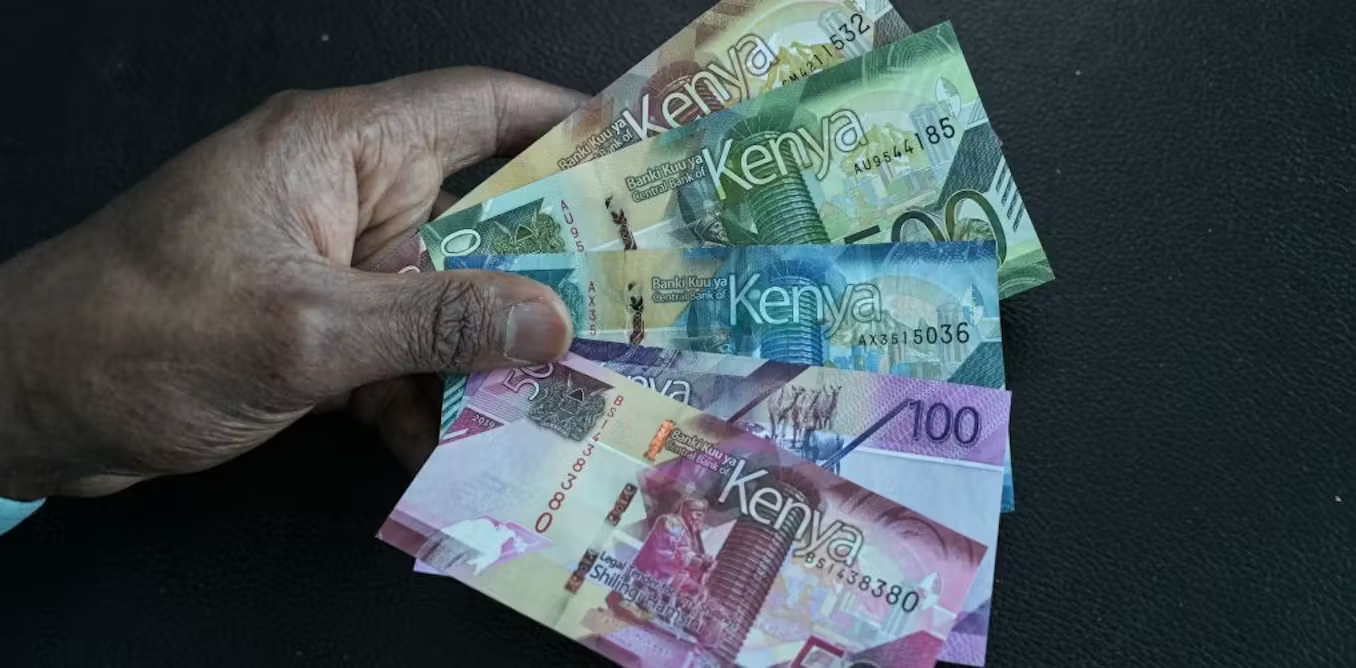
Kenya is set to miss out on emergency financing from the World Bank that it had sought to cushion the economy against the effects of the ongoing Middle East conflict, with the lender instead moving ahead with consideration of an earlier Sh97.1 billion ($750 million) loan request.
New disclosures from the World Bank show that its Board of Executive Directors is scheduled to consider Kenya’s Development Policy Operation (DPO) facility before the end of June. However, the country’s request for separate emergency financing does not appear on the agenda.
The development comes despite earlier indications from government officials that discussions on both funding requests were progressing simultaneously.
During a post-Monetary Policy Committee briefing last week, Central Bank of Kenya Governor Dr Kamau Thugge said negotiations with the World Bank were ongoing.
“We are still in the process of discussing with the World Bank on the DPO, and we hope that it will go to the board for discussion fairly shortly. So far there haven’t been any disbursements regarding the emergency financing, but it is an ongoing discussion, and we hope that this will be finalised quite shortly,” Dr Thugge said.
Kenya first sought the additional emergency funding during the World Bank and International Monetary Fund Spring Meetings in Washington in April as the country sought to strengthen its external financial buffers. The request came after foreign exchange reserves declined by approximately $1.2 billion between early March and early April 2026.
At the time, the government expressed hope that the World Bank would provide support beyond the Sh97.1 billion already earmarked under the DPO programme.
“With the World Bank, we hope that we can reach agreement on the Rapid Results Operation so that we can get additional financing over and above the Development Policy Operation. Our hope and expectation is that this money will come in this financial year (2025/26),” Dr Thugge said on April 17 while attending the Spring Meetings.
The DPO facility under consideration is designed to provide rapid financial support to countries facing development financing needs while supporting reforms aimed at poverty reduction, economic growth, improved governance and climate resilience.
The loan programme has faced delays since the 2024/25 financial year, partly due to the collapse of Kenya’s programme with the International Monetary Fund in March 2025 and concerns surrounding the country’s conflict of interest legislation.
Progress resumed after President William Ruto signed the Conflict of Interest Act into law in July 2025 following revisions by Parliament. The legislation introduced stricter measures aimed at preventing public officers from receiving undue influence or extending unlawful preferential treatment while carrying out official duties.
According to the World Bank, the proposed financing will focus on three broad objectives:
“To promote equity, efficiency and transparency in public finance. To foster more competitive and inclusive product and labour markets and to strengthen climate action”, the World Bank states.
Should the facility be approved before the end of the current financial year, the funds are expected to strengthen Kenya’s foreign exchange reserves at a time of growing global economic uncertainty.
The country’s reserves stood at $13.24 billion during the week ending June 11, equivalent to 5.6 months of import cover.
World Bank documents show that of the Sh97.1 billion under consideration, Sh53.1 billion will come from the International Development Association (IDA), which provides concessional financing to low-income countries, while Sh44 billion will be sourced from the International Bank for Reconstruction and Development (IBRD), which offers financing to middle-income economies.
The timing of the board’s decision is critical as Kenya grapples with fiscal pressures and prepares to implement the 2026/27 budget.
While presenting the budget to Parliament on June 11, National Treasury Cabinet Secretary John Mbadi acknowledged revenue collection challenges.
“The implementation of the 2025/26 budget has remained broadly on course despite emerging pressures on revenue performance and expenditure demands,” Mbadi told lawmakers.
He added: “On the revenue front, performance had fallen short of target due to slower than expected tax receipts largely driven by administrative constraints and a slowdown in economic activity.”
By the end of April 2026, government revenue collection had reached Sh2.658 trillion, falling short of target by Sh67.63 billion, while expenditure stood at Sh3.638 trillion, exceeding projections by Sh64.6 billion.
Kenya is expected to run a budget deficit of Sh1.15 trillion in the 2026/27 financial year, with the government planning to raise Sh1.03 trillion from the domestic market and Sh116.2 billion through external borrowing.
