

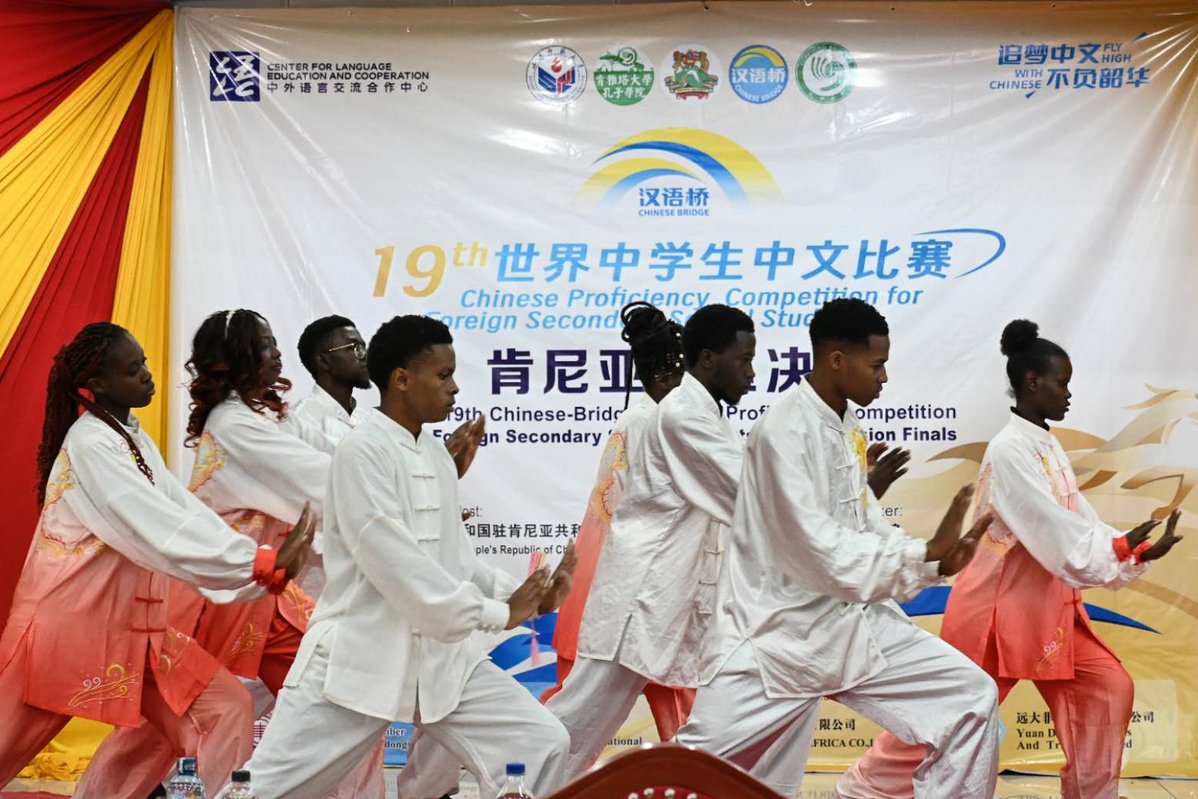
Kenyatta University’s Confucius Institute has begun developing a master’s degree program in Chinese studies as it seeks to position Kenya as a regional hub for Chinese language education amid deepening ties between China and Kenya.
The institute’s local director, Leonard Chacha Mwita, said the proposed program will build on the recently launched Bachelor of Arts in Chinese language, currently the only full major degree program of its kind in the East African nation.
The move marks a major expansion for the institute, which since its establishment in December 2008 has mainly offered certificate and diploma training in Mandarin to hundreds of students.

Unlike in the past, when graduates pursued postgraduate studies through partner universities in China such as Shandong Normal University, the proposed research-based master’s program is expected to admit students with honors degrees in Chinese studies and related disciplines from Kenya, across Africa, and beyond.
“Students may have the chance to conduct research not only within Kenya, but also in China, with the possibility of co-supervision. If the research project necessitates it, students may have the opportunity to travel to China to further their research,” Mwita said.
Once approved, the program is expected to make Kenya one of the few countries in Africa to host such a master’s degree.
According to Mwita, the new academic pathways are being driven by the rising demand from students seeking to progress beyond diploma level as opportunities linked to Chinese language skills continue to expand.
Building on Nairobi’s status as a center for business, diplomacy and international engagement in East Africa, he said Kenya is well-positioned to become a regional hub for the teaching of Chinese language and culture.
“There’s a demand for Chinese language and skills and these programs are marketing themselves,” he said.
With intensifying cooperation in various fields between the two countries, Chinese language learning has been gaining popularity in Kenya in recent years. China is now Kenya’s biggest trading partner, investor and contractor for infrastructure projects.
Mwita said three professors from Shandong Normal University, the institute’s long-time academic partner, are expected to join local scholars in September to help finalize the curriculum as the university moves to meet growing demand for Mandarin skills in infrastructure, business, tourism, education and technology.
“We know that after the undergraduate (program), people will still want to do the master’s. Previously, a certificate and a diploma used to be enough, but now the interest in Chinese language and culture is growing at a phenomenal level,” he said.
Among others, the master’s program is expected to include specialized tracks such as translation, second-language teaching, China-Africa relations and intercultural studies.
He noted that Kenya’s evolving education system, which now allows students to select Mandarin as a language subject from Grade 10, is likely to increase demand for qualified teachers in the coming years.
Rising enrollment
Schools are already seeking Mandarin instructors, while universities are expected to see rising enrollment as more secondary school graduates pursue Chinese language studies.
Beyond teaching, graduates are increasingly finding opportunities in banking, telecommunications, tourism, translation and infrastructure sectors linked to Chinese investments in Kenya.
Mwita revealed that banks had recently approached the institute seeking Mandarin-speaking graduates to support customer care and teller services for Chinese clients.
Construction firms involved in Chinese-funded projects, as well as technology companies such as Huawei, are also employing graduates with Mandarin skills, he said.
Tourism and hospitality businesses are similarly turning to Mandarin speakers to cater to the growing number of Chinese visitors to Kenya.
“We usually have people coming here with documents requiring translation. There are also conferences where interpretation is needed, and these are areas where our students can earn very well,” Mwita noted.
Mwita said that combining local and native Chinese lecturers and facilitating scholarships have enabled top-performing students to study in China for periods ranging from six months to one year.
– China Daily
